Please note...

Find a pet friendly care home
Maps4Pets

  
The time may come when an elderly person needs to move into a care home. For many, however, the fear of being separated from their cherished pet may cause many folk to avoid the subject altogether until they have no alternative.  And some actually refuse to go at all.
 
Pets are often the one remaining link an older person has with a deceased spouse; in many cases they are the sole reason the owner keeps shopping for food and warming the home.  Animals offer companionship and someone to talk to, and they give unconditional love. 
  
Six tips to finding a care home which takes pets
 
  1. Start looking for a home sooner rather than later.  If you are a relative who has the task of finding a home for your loved one, consider their overall needs, but don’t under-estimate the bond between an elderly person and their pet.
  2. Don’t assume that a home won’t take pets.  Much is dependent on the person in charge.  If they are animal lovers, they are better placed to understand the bond between pet and owner and are more likely to say “yes”.  So just ask if your pet can come with you.
  3. Older people need to choose pets carefully as they advance in years.  A small mature dog is more likely to appeal to a care home than an excitable puppy. 
  4.  Most homes will want to talk to a would-be resident (and meet their pet) before agreeing to Fido or Tiddles coming too.  Pets must be clean, healthy and up to date with vaccinations, flea treatments, worming etc and well behaved.   
  5. Talk to charities in the know. The Cinnamon Trust has been enabling elderly people and their pets to stay together for 25 years.  Its Pet Friendly Care Homes Star Rated Guide lists homes taking pets in the UK. The Cinnamon Trust will also send you a printed list of homes taking pets in the area you want.  They have a network of volunteers who help the elderly with pet care, either in private or care homes.  Maps4Pets has a map showing the Trust's listing of homes taking pets online.
  6. Be prepared and ready to argue your case. SCAS has a very useful page with tips and you can also point home managers in the direction of the page Care Professionals on their site where they can get more info
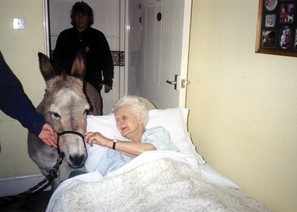
Diana the Donkey comes to visit
The Elisabeth Svendsen Trust donkeys visit care homes
 & bring lots of animal magic & laughter to staff & residents alike.  Photo copyright of EST.
 
Residents, staff and visitors can all benefit from pets 
 

There’s many a home manager who has sent a member of staff having a stressful day to have a quiet few moments and a cuddle with a resident pet.   Pets give everyone a safe topic of conversation.  They provide moments of merriment and laughter, and act as social catalysts.  Pets offer a talking point when grandchildren come to visit.  They can also lessen the amount of attention residents want from staff.  And the right sort of pet excels at lowering blood pressure and stress levels. 


And of course, pets help elderly people to feel needed and wanted, and to avoid the three plagues of care homes, identified by the Eden Alternativeas boredom, loneliness and helplessness.  
  
 
Finding a pet friendly care home is worth the effort


Researchby Dr June McNicholas and Dr Glyn Collis showed that elderly people who had been separated from their pets faced more problems than those who had not, as the former group:


  • Were more negative about the move into a home
  • Took longer to make friends and join in activities
  • Experienced more problems sleeping and had a greater need for sleeping tablets while they adjusted
  • Were reluctant to confide in staff, in case the real reason for their unhappiness would be trivialised. 


The researchers from Warwick University concluded that having visiting animals did not alleviate such personal distress.
 
Strive to uphold the bond between pet and owner


It’s easy to assume that an elderly person and their pet will need to part, when the time comes for the former to move into a home, and that both “will soon get over it”.  It doesn’t need to happen.  Many homes put themselves out to be pet friendly, as staff understand and appreciate the therapeutic benefits of the animal-human bond and the relationship between elderly person and their pet.


There will lots of information to gather when finding a care home for an elderly relative and it's not an easy ride for many of us. But do your research, and an elderly person and pet could have a good many happy years together, while giving others many magical moments too - and it could mean a relative settles far more quickly and happier if their loving, loyal friend is by their side.
 
therapykitten
Useful resources
 
Cinnamon Trust has volunteers around the UK who can help with pet care for the elderly and terminally ill in the UK in both care homes & private homes. It also has a list of homes around the UK which take pets in with their owners, and you can find a map showing these homes at Maps4Pets 
 
The Society for Companion Animal Studies have a list of questions to ask a care home if you're looking for a pet friendly care home, plus useful information on finding a pet friendly care home, preparing a case for support, questions to ask a housing manager, issue a housing manager might raise.
 
Pets for Life - a campaign to highlight the widespread lack of a coherent policy on pet ownership in residential care homes and the sheltered accommodation throughout the UK.  This campaign is endorsed by the Dogs Trust, Anchor Housing & Hanover Housing.


Go to our Site Map 


Please...
  • Always consult with your GP before starting any new form of exercise
  • Note that animals are unpredictable - and they may not always want to be seen or found.  We cannot guarantee how close you may or may not get to animals in specific programmes - common sense must prevail.
  • WASH YOUR HANDS after touching animals BEFORE eating or snacking.  (It could be a good idea to take some antiseptic wipes or handwash with you, just in case loo facilities don't provide soap.)  Do not let children put their fingers into their mouths or suck thumbs after touching animals - it's common sense!
  • The amount of contact you can have with animals varies from one place to another & one animal to another.  Common sense must prevail.   
  • Before you visit places, check that there are no current regulations/conditions which could mean that they are closed. Also check for opening hours. 
  • Take your rubbish home with you, at animals' requests
  • Note our disclaimer  - we cannot be held responsible for any injury, damage or otherwise to you or any third party as a result of your taking part in any activities on this site. 
  • Note that we do not sell products or provide voluntary opportunities.  Any product or service you may purchase is subject to the terms & conditions, disclaimers & policies of the companies selling them.    We are simply referring you on & raising your awareness that such opportunities exist
  • This site is part of the Animal Human Wellbeing family


  Publisher Website!


Powered by Create